

In the daily operation of hospitals and clinics, few items are as ubiquitous—and as overlooked—as the medical bed sheet. For patients, it's the first thing they feel when they lie down. For clinicians, it's a critical barrier against cross-contamination. For administrators, it's a line item in the budget.
For years, the industry has relied on SMS+PE (SM+PE) laminates—produced via extrusion coating or adhesive lamination—as the workhorse material for disposable bed sheets. These composites offer the fundamental protection required in healthcare settings .
But here's the truth that rarely gets discussed: Standard SMS+PE bed sheets come with significant hidden problems—problems that affect patient comfort, clinical outcomes, and even operational efficiency.
Having analyzed the latest developments in medical textile engineering, I want to share why advanced SMS+PE laminates are evolving to address these challenges, and how smarter material design at HUATAO is finally delivering on the promise of "protection without compromise."
The Core Challenge: Why "Good Enough" Is No Longer Acceptable
Traditional SMS+PE composites were designed with a single priority: barrier protection. And they deliver on that. The PE film provides an effective shield against fluids, while the SMS offers strength and structure .
But in focusing solely on barrier performance, conventional laminates created a cascade of secondary problems:
- Patient discomfort from heat and moisture buildup
- Delamination failures during use ("zipper effect")
- Process-specific defects that compromise quality
- Noise issues that disturb patients in quiet settings
- Environmental concerns from multi-material construction
The market is no longer satisfied with protection alone. Today's healthcare environment demands materials that protect and perform—for patients, clinicians, and the planet.
The Problems: What Standard SMS+PE Bed Sheets Face in the Real World
Problem 1: The "Zipper Effect" and Delamination Risk
The meltblown layer in standard SMS has low tensile strength, creating a weak bond with PE film. During patient movement, the PE can separate from the SMS like a "zipper," compromising barrier integrity. This is a patient safety issue, not just a defect.
Problem 2: The Breathability Paradox
Solid PE film seals the material, stopping fluids but trapping heat and moisture. Standard laminates have poor breathability (MVTR below 1,000 g/m²/24h), causing sweating and clamminess. For vulnerable patients, this can lead to skin maceration and pressure sores.
Problem 3: Process-Specific Failure Modes
- Extrusion Coating: No breathability; stiff feel; leakage with lightweight substrates
- Adhesive Lamination: High adhesive use (4gsm); heat damage risk; skin sensitivity concerns; costly equipment ($400k+)
- Hot-Melt Powder Bonding: Uneven distribution; poor peel strength; surface unevenness
- Thermal Calendering: 30-40% breathability loss; inconsistent bonding; incompatible melting points
Problem 4: The Noise Factor
Extrusion-coated laminates produce a loud "crinkle" when patients move. In quiet ICUs, this noise disturbs rest and consistently appears in patient feedback.
Problem 5: Raw Material and Bio-compatibility Concerns
Lower-grade polymers may contain impurities that cause skin reactions or weaken fabric. When materials contact skin—especially compromised skin—quality is a patient safety issue.
Problem 6: The Environmental Crossroads
SMS+PE composites (PP + PE) are difficult to recycle. PP takes 100-500+ years to biodegrade. With over 12 million tons of PE medical waste generated annually, non-recyclable bed sheets are becoming a sustainability liability.
At HUATAO, we've spent years studying these industry pain points. Our SMS+PE laminated nonwoven fabric is specifically engineered to overcome the limitations that plague conventional products.
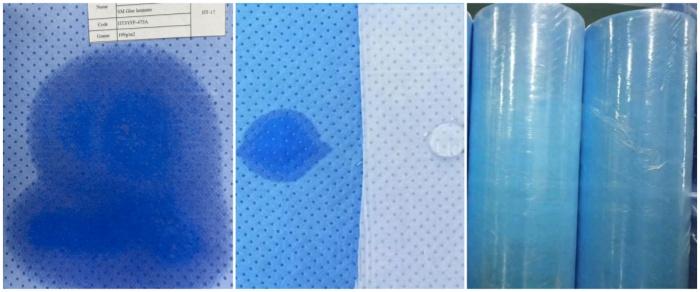
### ✅ Superior Layer Bonding—No "Zipper Effect"
We've addressed the fundamental weakness of standard SM+PE constructions. While conventional SMS has a meltblown layer with relatively low tensile strength that compromises adhesion, our optimized structure incorporates an additional (fluffy ultra-thin spunbond) layer that significantly improves bonding with the PE layer while enhancing absorbency .
This improved structure achieves superior peel strength between layers, eliminating the "zipper effect" and ensuring barrier integrity remains intact even under dynamic stress. The result: No delamination. No barrier failure. No surprises during use.
### ✅ Exceptional Hydrophilic Performance with High Absorbency
In medical applications, keeping the patient dry is critical. Our SMS laminated nonwoven fabric features outstanding water-absorption properties with absorbent rates of 500-800% of fabric weight and absorption speed of just 1-2 seconds .
This superior absorbency:
- Keeps the patient dry and comfortable
- Rapidly absorbs fluids like blood and other bodily fluids
- Reduces cross-infection risks
- Maintains a clean environment essential for patient safety
The fluffy ultra-thin spunbond structure enhances the fabric's Water absorption properties, making it significantly more effective than standard laminates .
### ✅ Premium Raw Materials for Bio-compatibility
We select only the highest-grade polymers to produce our SMS laminated nonwoven fabric . These high-quality material are carefully chosen to ensure the final product meets or exceeds international quality standards, including ISO 10993 for skin contact.
Using premium raw materials delivers:
- High strength and durability
- Excellent bio-compatibility—ensuring no adverse reactions when in contact with human skin
- Consistent performance across production batches
- Ideal for applications where direct contact with skin or wounds is inevitable
When your product contacts human skin—sometimes for extended periods—you need absolute confidence. Our material provides that confidence.
✅ High Strength for Demanding Applications
Strength is a vital characteristic of our SMS laminated nonwoven fabric . In medical settings, the fabric must withstand various mechanical stresses:
- Patient movement and repositioning
- Transfer between surfaces
- Cutting and sewing during product manufacturing
- Sterilization processes
Our fabric maintains integrity under all these stresses, delivering consistent performance and reducing the risk of catastrophic failure during use. Tensile strength of 35-45N ensures reliable protection .
✅ Tailored for Medical Surgical Consumables
Our SMS laminated nonwoven fabric is specifically designed for the medical surgical consumables industry . We understand the unique requirements of this field:
-Super absorbency for fluid management
- Softness for patient comfort
- Barrier properties for infection control
- Breathability ensuring comfort during prolonged use
- Excellent Barrier performance preventing bacterial and viral penetration
The breathability ensures patients remain comfortable during extended bed rest, while the Barrier performance provides reliable protection .
✅ Available in Multiple Specifications
We offer our SMS+PE laminates in:
- Basis weight: 60gsm to 200gsm
- Colors: Light blue, dark blue, and other colors upon request
- Width: 20cm-260cm
- Features: High absorbent nonwoven fabric + waterproof PE film
The Technology Behind the Performance
It's not just about the materials; it's about the precision of the bond. Our manufacturing process utilizes advanced composite equipment with quality management systems compliant with ISO9001 and ISO13485 standards .
Key quality advantages:
- Optimized layer structure that addresses the meltblown layer weakness
- Complete inspection process with professional inspectors
- Consistent quality batch after batch
- Customization capabilities to meet specific requirements
The result is a product that performs consistently, meeting the rigorous demands of medical applications worldwide.
What challenges have you encountered with medical bed sheet materials in your work? Have you noticed the shift toward more patient-friendly composites in your market? I'd love to hear your experiences in the comments.
can not be empty
can not be empty

HUATAO GROUP - Spunlace Nonwoven Fabric
Address: No.298 Zhonghua North Street, Shijiazhuang 050000 China.
Tel: +86 0311 80690567
Email: sale03@huataogroup.com
 WhatsApp & WeChat : +8618033766115